
When Should You Send a Trademark Cease and Desist Letter? 7 Signs It’s Time to Act
You found another company using your brand name. Maybe they are selling similar products. Maybe they launched a website using a name that looks almost identical to yours. Or perhaps you discovered the use while reviewing a trademark monitoring report.
Your first question may be: “Should I send them a cease and desist letter?”
The answer depends on the circumstances. A cease and desist letter can be an important step in trademark enforcement, but it should not be treated as an automatic response to every use of a similar name.
The goal is to understand what the other party is doing, evaluate your trademark rights, and determine whether a demand to stop the use is appropriate.
What Is a Trademark Cease and Desist Letter?
A trademark cease and desist letter is a formal communication notifying another party that you believe its use of a particular name, logo, or other branding conflicts with your trademark rights and requesting that the use stop.
The USPTO describes a cease and desist letter as correspondence that identifies potentially infringing trademark use and demands, or proposes, that the recipient stop using the accused mark.
A letter is not the same thing as filing a lawsuit. It is generally an enforcement communication that may be used before litigation or as part of a broader enforcement strategy.
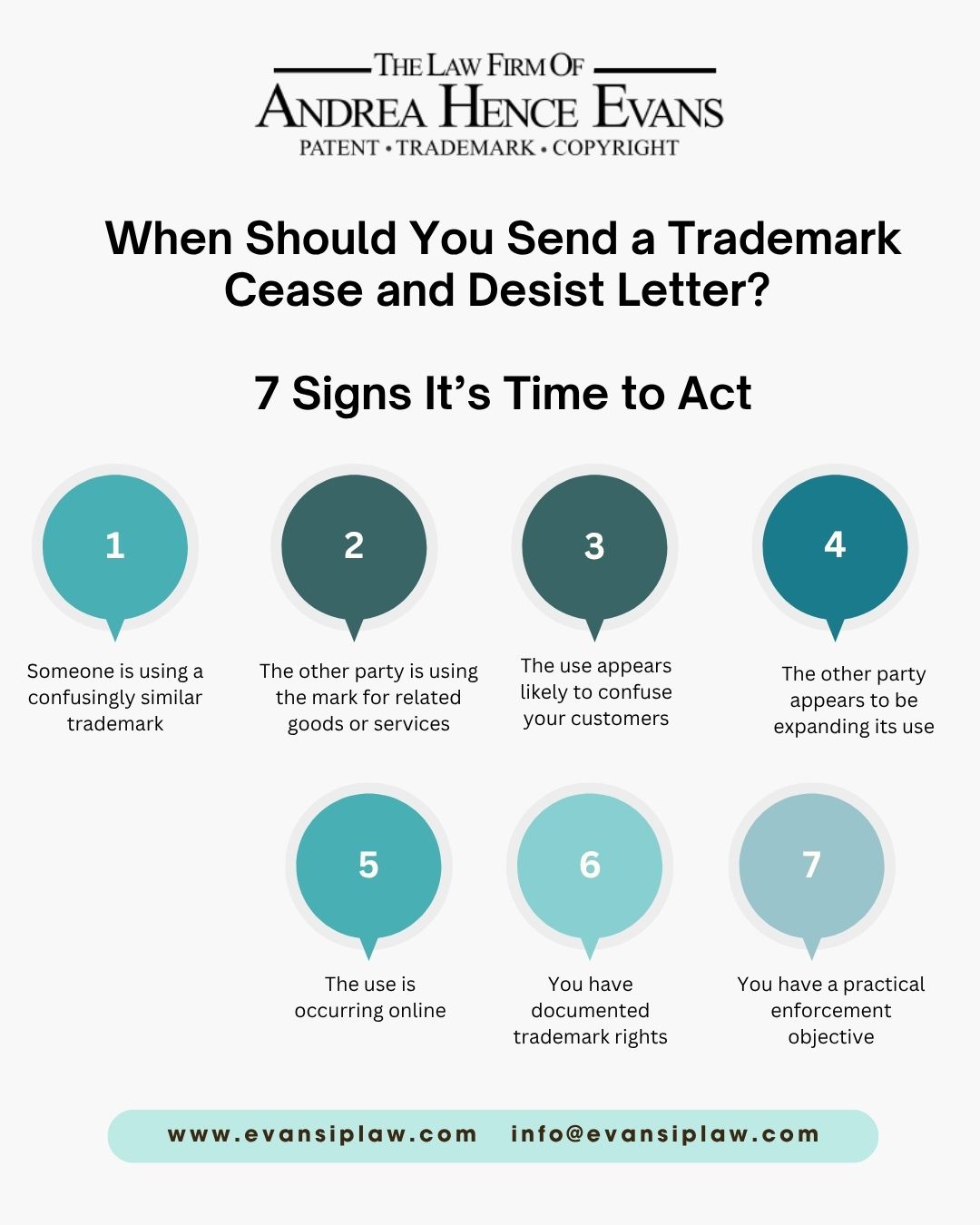
7 Situations That May Justify a Cease and Desist Letter
- Someone is using a confusingly similar trademark
Similarity alone does not automatically establish infringement. The important question is whether the use is likely to cause consumers to believe that the parties’ goods or services come from, are affiliated with, or are sponsored by the same source.
The USPTO identifies likelihood of confusion as a central consideration in trademark infringement claims.
Before sending a letter, consider more than whether the names look alike. Look at the goods or services, how they are marketed, where they are offered, and other relevant circumstances.
- The other party is using the mark for related goods or services
Two businesses can sometimes use similar marks without creating a trademark conflict because they operate in sufficiently different areas.
For example, a similar name used for unrelated goods may present a different analysis from a similar name used for products competing with yours.
That is why a trademark review should look at the actual use—not just the spelling of the mark.
- The use appears likely to confuse your customers
If customers are contacting you because they believe the other business is connected to you, that information can be important.
Save those communications rather than relying on memory. Screenshots, emails, messages, advertisements, product listings, and website pages may help document what consumers are seeing.
- The other party appears to be expanding its use
Sometimes a potential conflict starts small.
You may discover someone using your brand on a social media account. Later, you may find a website, products, advertising, or a trademark application associated with the same name.
That is one reason trademark monitoring can be valuable. The USPTO notes that trademark owners are responsible for enforcing their rights, even after obtaining a registration.
- The use is occurring online
Online use can involve websites, social media, marketplaces, advertisements, apps, and other digital platforms.
If the use is potentially infringing, a cease and desist letter may be one part of the enforcement strategy. Depending on the platform and circumstances, a separate platform complaint or takedown process may also be available.
- You have documented trademark rights
Your enforcement position can depend significantly on the rights you actually own.
A federal registration on the Principal Register can provide important legal presumptions regarding validity, ownership, and exclusive nationwide use in connection with the listed goods or services.
However, registration is not the only issue. Common-law rights and other facts can also matter.
Legal verification needed: The scope and strength of your rights should be evaluated based on the specific mark, registration status, dates of use, goods/services, geographic activity, and applicable law.
- You have a practical enforcement objective
Before sending a letter, ask what you want the recipient to do.
Do you want the company to stop using the mark? Remove a website? Change its branding? Stop selling particular products? Transfer or abandon a trademark application? Provide information about its use?
A letter is more useful when the requested action is clear and tied to the specific conduct at issue.
If you have discovered someone using your trademark or are considering taking action to protect your brand, The Law Firm of Andrea Hence Evans, LLC can help you evaluate your options.
Schedule a consultation with The Law Firm of Andrea Hence Evans, LLC: www.evansiplaw.com