If you’ve ever looked at a patent and wondered why the claims read like a blend of legalese and engineering jargon, you’re not alone. But there is a method to the madness—every patent claim is built from three required parts, and each part plays a critical role in defining the legal boundaries of the invention.
Let’s break down the anatomy of a claim so you can understand how these pieces work together to protect an inventor’s idea.
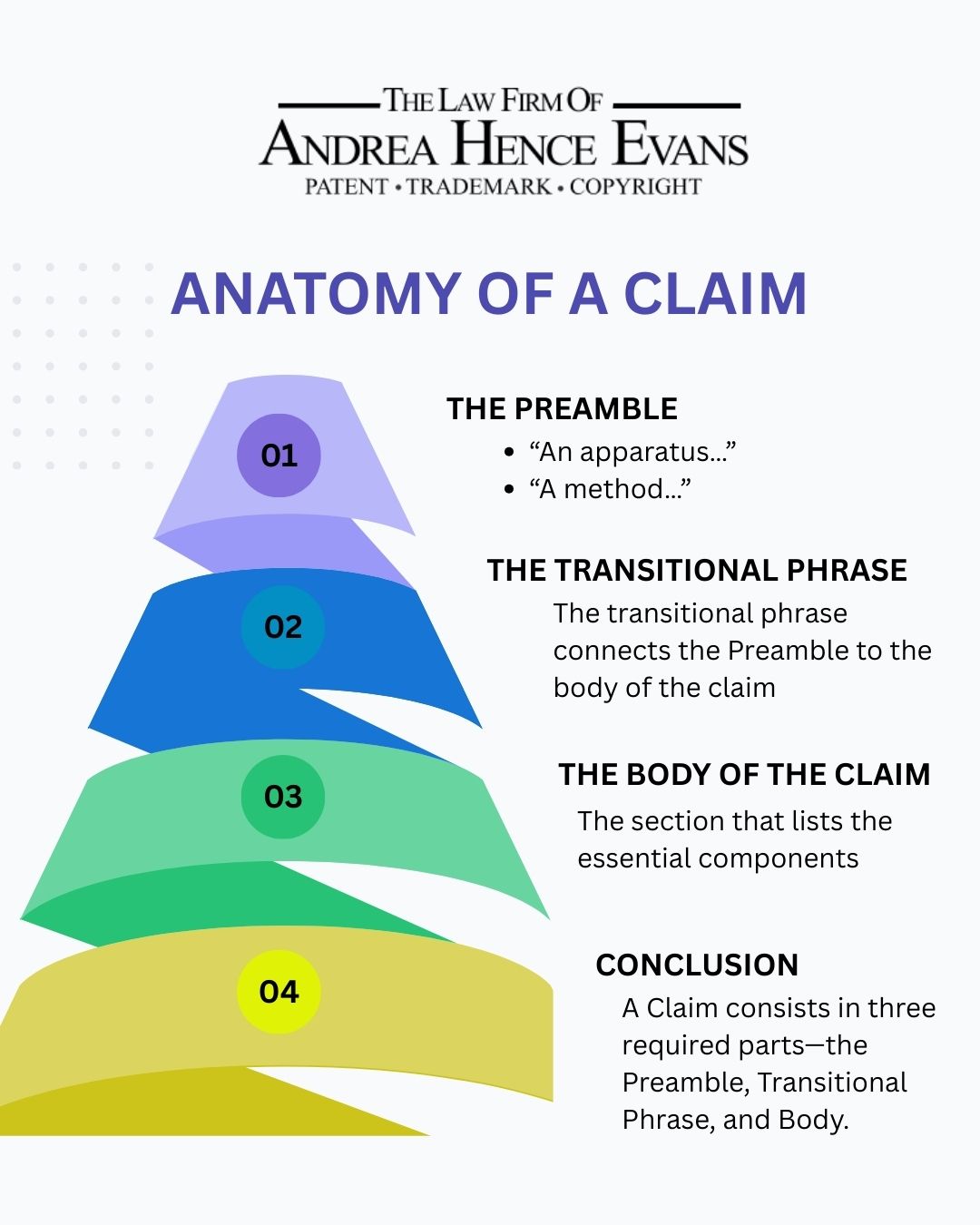
1. The Preamble (The Introduction)
The Preamble is the warm-up line—the part that introduces what type of invention you’re claiming.
It typically starts with something like:
- “An apparatus…”
- “A method…”
- “A system…”
- “A composition…”
What It Really Does
In most cases, the Preamble does not limit the scope of the claim.
For example:
“A boot for exercising…”
This still claims a boot, not a boot that must be used for exercising. The “intended use” language usually doesn’t narrow the claim.
When It Does Matter
If a Preamble gives essential structure or is relied upon to distinguish prior art, then it can become limiting. But as a general rule, think of it as the label—not the fence.
In Dependent Claims
When a claim depends on another, it must reference it:
- “The boot according to claim 1…”
- “The method of claim 3…”
This ties dependent claims back to their parent and adds additional limitations.
2. The Transitional Phrase (The Connection)
This is the smallest but most powerful part of the entire claim. The transitional phrase connects the Preamble to the body of the claim—and controls how wide or narrow the claim’s protection is.
Here are the big players:
“Comprising” – The Open Door
This is the broadest transitional phrase.
“Comprising” means including, but not limited to.
If your claim says:
“A boot comprising a sole, an upper, and a fastening mechanism…”
Someone who adds LED lights, Bluetooth, or rocket boosters still infringes—because those extra elements don’t matter.
This is why “comprising” is the most popular transitional phrase in U.S. practice.
“Consisting of” – The Closed Door
This phrase is narrow.
“Consisting of” means limited to exactly what you list, and nothing more.
If your claim says:
“A composition consisting of A, B, and C…”
Adding D means the accused product is not infringing.
Why Use Both?
Smart drafting often includes:
- Broad claims using “comprising”
- Narrow claims using “consisting of”
This strategy casts a wide net while also providing fallback positions that may survive prior art rejections.
3. The Body of the Claim (The Details)
While not in your outline, it’s useful to note: after the transitional phrase comes the claim body—the section that lists the essential components, steps, or features of the invention. This part defines the boundaries of what is—and is not—covered by the patent.
Final Thoughts
A patent claim may look intimidating, but when you break it down into its three required parts—the Preamble, Transitional Phrase, and Body—the structure becomes clear and strategic. The words you choose, especially in that tiny transitional phrase, can dramatically affect the scope of protection.
Contact The Law Firm of Andrea Hence Evans, LLC to ensure your claims are strong and enforceable.